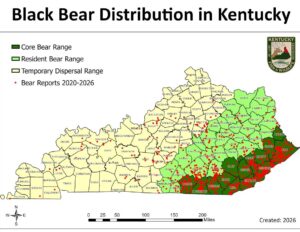
Black bear sightings have become increasingly common across Kentucky—including in places where residents are not accustomed to seeing them.
More than a half-dozen bear sightings have been reported in Russell County in recent months. Across the Lake Cumberland area and southeastern Kentucky, bears have been captured on doorbell cameras and dash cams, and spotted in backyards, neighborhoods and other developed areas.
WJRS NEWS spoke with Tristan Curry, a wildlife biologist with the Kentucky Department of Fish and Wildlife Resources’ Bear and Elk program.
Curry says this is normal bear behavior. Young male bears often leave eastern Kentucky in late spring and summer after being pushed out by older, more dominant males. Those young bears may wander for weeks in search of food, habitat and potential mates.
As fall approaches, bears also enter a period known as hyperphagia, when they become more active and eat as much as possible to gain weight before winter.
Curry says bears may be drawn to homes and farms by livestock feed, pet food, birdseed, garbage or dirty barbecue grills. He says the first thing residents should do is remove those possible food sources.
Black bears can travel more than 20 miles in a single day when left undisturbed. Curry says many of the young bears seen outside their normal range will eventually return to the mountains.
We asked Curry whether every bear sighting should be reported:
Black bears naturally fear people and dogs, and dangerous encounters are extremely rare. Still, wildlife officials say people should never approach or feed a bear.
Residents in areas where bears have been seen should keep garbage inside a garage or secure building, bring pet food indoors, clean and store grills, and take down bird feeders. Kentucky law prohibits feeding bears or knowingly leaving unsecured food where they can eat it.
Curry says there is plenty of information about black bears online, but not all of it is accurate. He recommends using information from established wildlife sources.
If you encounter a bear, do not approach it, feed it or run from it. Give the bear plenty of space and a clear way to leave.
If a bear poses an immediate threat, Curry says you should make yourself appear large, yell and wave your arms to scare it away. Contact local law enforcement if there is an immediate danger.
More information is available through the black bear section of the Kentucky Fish and Wildlife website https://fw.ky.gov or www.bearwise.org
Bear sightings may also be reported to the Kentucky Fish and Wildlife information center at 1-800-858-1549, Monday through Friday from 8:00 a.m. — 4:30 p.m.